
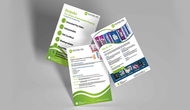
Why Printed Marketing Collateral Still Wins in Healthcare and Finance
Posted by Oliver Inc. on 13th Aug 2026
Digital marketing gets most of the credit. Budgets chase impressions, email open rates, and retargeting pixels while printed marketing collateral gets treated like a line item nobody's gotten around to cutting yet. We'd push back on that. In healthcare and in funding, print isn't hanging around out of habit. It's doing work that digital genuinely hasn't replaced, for reasons that are more practical than sentimental.
Your Phone Stays at the Door. Printed Marketing Collateral Doesn't.
Pharmaceutical reps and healthcare vendors deal with a constraint most industries don't face: a significant portion of hospital floors and outpatient clinics restrict or outright ban mobile devices in patient care areas. A tablet that can't pass the front desk isn't a marketing tool. Print marketing materials don't have that problem. A rep walks in with a product detail piece, a study summary, or a clinical overview and leaves it with a prescriber who reads it between appointments. That piece stays on the desk. The email follow-up may never get opened.
Waiting rooms work differently than most digital touchpoints. A patient sitting with your brochure about a care option, a specialist program, or a referral service reads it in a way they wouldn't scroll through an ad. There's no competing notification, no tap-to-dismiss reflex. Printed marketing collateral pulls a slower kind of attention because the person reading it is making a decision about their own health, and that's a fundamentally different state than casual browsing. Physical marketing assets in healthcare sit with people while they're actually thinking something through, and what patients absorb during that time shapes what they ask about and what they do next.
Hospital procurement teams read something into the quality of what you put in front of them before they read the copy itself. Paper stock, coating, print accuracy, all of it communicates something about the organization behind the piece. Brochures and flyers that look like they were run off at a corner copy shop tell a specific story. The brand collateral that earns a place in a buying conversation is the kind that looks like it came from a company that takes its own work seriously.
Is Your Printed Marketing Collateral Built for the Funding Room, or Just the Office Shelf?
High-stakes financial decisions happen face to face. Investor meetings, grant presentations, bank financing conversations, private equity diligence sessions, these are all rooms where decision-makers sit with materials in their hands. The question you should be asking more often is whether your print is calibrated for that room or just present in it.
A standard brochure in a VC partner meeting isn't going to move anything. A custom-printed pitch deck with clean information hierarchy, accurate financial detail, and business cards design that actually reflects your company's identity is a different object entirely. It says something about how your organization operates before the first sentence of the pitch. In funding contexts, where relationship and credibility do a lot of the heavy lifting, that impression adds up fast.
The printed marketing collateral that performs in these settings is built for the specific audience, not for general distribution. Direct mail marketing still runs hard in financial services precisely because physical pieces land differently than email. A wealth management firm sending printed mailers to high-net-worth clients gets a different response rate than the same firm's email campaign, partly because email gets filtered and partly because a piece sitting on a physical desk occupies a kind of space an inbox item never will.
The answer to why your sell sheet isn't selling is usually a format mismatch. A piece designed for a general audience dropped into a relationship-driven, high-stakes context doesn't do the job. Offline marketing tools in these industries need to speak to the specific person on the other side of the table, and that takes more intentionality than most organizations apply when deciding what to print and how.
Nonprofits pursuing grant funding deal with the same thing. A printed impact report or program overview handed directly to a foundation program officer carries weight that a PDF attachment doesn't. Foundation officers read a lot of proposals. The organizations that print well are the ones that stay in the conversation.
What Good Printed Marketing Collateral Looks Like When It Actually Has to Work
The version of print that underperforms is almost always the version that got treated as an afterthought. An organization orders a tri-fold and a folder, runs them at the lowest unit cost, and wonders why they're not landing. Custom print solutions exist because standard formats built without strategy don't carry a brand. They just hold information.
Building a brand story through print collateral in healthcare requires precision. Materials need to communicate expertise and reliability before a reader decides whether to trust the organization behind them. In funding contexts, the materials need to signal credibility and preparation. Paper quality, binding, finish, and information hierarchy all have to serve that goal in a coordinated way. We work with clients in both spaces, and the organizations investing intentionally in print, choosing the right stock, the right format, the right finish for their specific audience, are consistently the ones whose materials get kept after the meeting ends.
Print collateral closes deals in these industries because both run on trust, relationships, and careful evaluation. A poorly produced piece signals that a company doesn't sweat the details. A well-produced one argues the opposite without having to say so. Printed marketing collateral built for a specific audience in a specific context isn't just a physical version of your digital content. It's a separate argument for your brand, made in a medium that gets held, referenced, and returned to in a way a website never quite manages.