Custom Medical Packaging on Certified Board
Posted by Oliver Inc. on 24th Nov 2026
Your sustainability team wants FSC, SFI, or PEFC-certified board on your custom medical packaging, and your QA team wants the carton spec left alone. You can satisfy both. When the certified board matches the grade and caliper already on your approved spec, the carton runs the same on your line, and your quality unit reviews a narrow sourcing change instead of a new component. We'll cover why QA pushes back, what certified board changes and what it leaves alone, which tests to run first, and how to bring the request to your own QA team.
Why Does QA Flinch When Someone Says "Sustainable" Custom Medical Packaging?
Your QA team pushes back because the regulations give them the job. Under 21 CFR 211.22, the quality unit holds the authority to approve or reject packaging materials, and FDA medical packaging regulations treat the carton as a controlled component.
Device makers carry the same duty under 21 CFR Part 820, which has incorporated ISO 13485 since February 2026. The carton protects what's inside, and pharmaceutical packaging's role in stopping contamination puts any material change squarely in QA's territory.
To a QA lead, "sustainable" usually signals unfamiliar board, and unfamiliar board means change control, new incoming inspection criteria, and line trials. Their concern about custom medical packaging is specific.
A sheet from a different mill can carry a different stiffness, coating, or moisture content, and any of those can turn into a crushed carton or a cartoner that stops every few minutes. Some suppliers add to the problem by stocking certified board in a single caliper. If your approved spec calls for 20 pt SBS and the supplier only carries certified 16 pt, you're now facing a carton redesign with new structural samples and a fresh round of testing.
Will Certified Board Change How Your Custom Medical Packaging Runs on the Line?
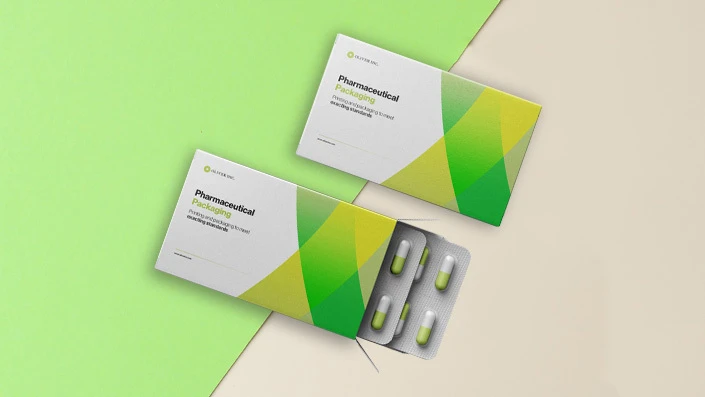
Not when the board matches. Certification tracks where the fiber came from through a documented chain of custody. The mill grade sets caliper, stiffness, and coating. When we source certified stock in the same pharmaceutical-grade board and caliper your spec already lists, your custom medical packaging scores, folds, glues, and feeds the cartoner the way your current cartons do.
The fear that a greener board will crush or crack usually comes from projects where the board grade changed along with the certification. Recycled paperboard often runs less stiff than virgin SBS at the same caliper, and it can crack on tight folds such as a reverse tuck. Certified virgin SBS at your approved caliper keeps the mechanical properties you already qualified.
Medical device packaging follows the same logic, with one extra check. Certified paperboard covers the outer carton, and your sterile barrier systems, such as the Tyvek pouch or sealed tray, stay exactly as you validated them.
ISO 11607 can count the carton as protective packaging within the full packaging system, so if your packaging validation included the carton in distribution testing, ask QA whether matched board needs a repeat run. The seven types of medical packaging each carry their own standards, and certified board only touches the paperboard layer. For custom medical device packaging, that keeps the question narrow: same carton, same caliper, different fiber source.
What Stays Exactly the Same on Certified Board?
Nearly everything on the carton. Your dieline stays put, so dimensions, score positions, and glue flaps don't move.
Tamper-evident packaging features such as glue seals and perforated tear strips run on the same structure and tear the same way. That matters for OTC cartons under 21 CFR 211.132 and for prescription brands adding tamper-evident pharmaceutical packaging to GLP-1 lines. Barcodes stay on the same flat panels. We keep your inks, coatings, and adhesive, so the rest of your approved medical packaging materials list holds.
One element changes: the artwork. To print an FSC, SFI, or PEFC claim on the carton, the printer needs chain-of-custody certification, and the on-product label carries a license or certificate code. Adding that logo counts as an artwork revision, so your QA team reviews it the way they review any labeling change. Plan one extra proof cycle for it, and place the logo on a panel where it doesn't compete with Drug Facts, warnings, or the barcode.
What Should You Test Before the First Certified Run?
We cut certified samples on your production dieline and send them before your first certified order of custom medical packaging, so you test on your own equipment instead of trusting a spec sheet. Oliver, Inc., for example, keeps pharmaceutical-grade paperboard in stock in multiple calipers, which means samples arrive in the exact caliper your spec lists.
Run these checks and record each result against your current spec:
- Measure caliper and confirm it falls inside your spec tolerance.
- Fold every score by hand and look for cracking on the reverse tuck and glue flap.
- Run samples through your cartoner at normal line speed and watch pickup, erecting, and closing.
- Confirm your current hot melt or cold glue bonds on the glue flap.
- Scan every barcode and open every tamper feature.
- Run your standard compression check if cartons stack in distribution.
Those records become most of the file QA needs. Time the trial to your reorder calendar, too. If your sustainability target falls in September and your next reorder ships in June, run samples in April so testing and artwork approval finish before you issue the PO. The certified board then goes into a run you'd already planned, and you avoid placing a special order just to hit a date.
How Do You Pitch Certified Custom Medical Packaging to Your Own QA Team?
Bring them a narrow change with the paperwork attached. Give your QA lead a one-page comparison for your custom medical packaging that lists the current board and the certified board side by side: grade, caliper, coating, and mill. Attach the chain-of-custody certificate, which they can verify in the FSC, SFI, or PEFC public certificate databases, along with your line trial results and the artwork proof showing the new logo. We supply the board specs and certificates for that packet.
Your QA team still decides what level of change control applies and whether any packaging validation needs repeating. Matched specs and a complete packet let them make that call in one review instead of a string of follow-up requests.
Certified board fits into your existing carton when the grade and caliper match, the trial runs on your line, and the timing follows your reorder schedule. The spec sheet you already have holds most of what your custom medical packaging needs to move onto certified stock.