Custom Medical Packaging Choices Nutraceutical Teams Should Nail Down Before Scaling
Posted by Oliver Inc. on 3rd Feb 2026
When a nutraceutical line starts moving fast, custom medical packaging stops being “a box and a label” and becomes a system. It protects potency. It keeps your line running. It makes compliance easier. It reduces common headaches such as scuffed cartons, peeling labels, crushed shipments, slowdowns at the folder-gluer, and avoidable rework.
We see brands obsess over flavors and formulas (as they should), then treat secondary packaging like an afterthought. That’s how you end up paying twice: once for rushed fixes, and again for the relaunch.
Below is a practical, operations-minded guide to choosing the right cartons, packaging formats, and stickers & labels, built for nutraceutical realities like high-volume lines, LSE bottles, optional vs. mandatory security, and transit validation.
Start With The Carton Style Your Line Can Actually Run With
Not all folding cartons behave the same once they hit speed.
Straight Tuck End (STE)
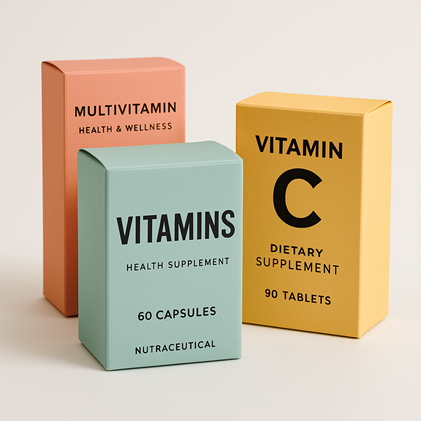
Simple. Predictable. Great for lightweight items like smaller bottles and pouches. If you’re early-stage, STE keeps tooling and setup straightforward. It’s often a clean entry point for branded folding cartons.
Reverse Tuck End (RTE)
A common workhorse for nutraceuticals. The opposing tuck directions can improve closure stability and make the unboxing feel tighter. For a lot of wellness SKUs, RTE is a smart middle ground between simplicity and shelf discipline.
Tuck Top Auto-Bottom (TTAB)
If your operations team is chasing throughput, TTAB earns a look. The bottom locks automatically, which supports high-speed, automated lines and reduces handwork. It’s also helpful when the product is slightly heavier and you want more bottom strength without slowing the line.
Blister Card Backer
When you’re selling single-dose supplements, trial packs, or hang-ready retail formats, blister systems shine. Visibility matters. Theft resistance matters. Planogram-friendly display matters. And yes—blister box is the best choice for health and wellness products when you need protection plus a clean retail presentation that doesn’t look “clinical.”
If you’re comparing options, keep one question front and center: are you optimizing for shelf impact, line efficiency, or freight resilience? You can hit all three, but you rarely hit them with the same structure and substrate.
Tamper Evidence in Nutraceuticals is Optional (until it isn’t)
For most vitamins and dietary supplements, tamper-evident features are typically a business decision, not a blanket federal mandate. Still, many brands choose TE because the downside of a tampering incident is brutal, recalls, liability exposure, lost trust, and retail fallout.
There are two common routes:
1) Integrated tamper evidence (perforations, tear strips)
Perforations are cost-friendly at scale because they’re built into the die-cut. The hidden trade-off is strength. Perfs weaken board panels, reducing compression performance during stacking and shipping. If you add perforations, you may need to offset the strength loss with smarter grain alignment or higher caliper.
2) Applied tamper evidence (security seals via labels)
Security seals add material cost and add a labeling step. That can mean extra equipment on the line and potential efficiency losses. The upside is flexibility—especially if you need “distinctive by design” features like branded patterns, serialized identifiers, or specialty finishes.
This is where stickers & labels become more than decoration. They can be functional security. They can also be your fastest path to a TE upgrade without redesigning the entire carton.
Child-Resistant Triggers Can Reshape Your Entire Packaging Plan
Child-resistant packaging isn’t a “nice-to-have” when regulations apply, it’s non-negotiable. Supplements with higher-risk profiles (iron thresholds, child-appeal formats like gummies in certain contexts) can force CR decisions that cascade into inventory, tooling, and quality systems.
CR cartons often require multi-step opening mechanisms (push-and-slide, pull-tab systems) that create real OEE penalties. More folds. More precision. More glue points. More dwell time. Lower ideal cycle times.
If you’re running CR cartons at volume, adhesive selection becomes strategic, not cosmetic:
- Cold glue can be solid but slower due to drying time.
- Hot-melt adhesives set fast and help protect throughput on complex folds and lock points.
This is the kind of detail people forget—until the line slows and you’re trying to hit a ship date.
SBS vs. FBB and Why “Cheaper Board” Can Cost More Later
Board selection is where finance and quality collide.
SBS (Solid Bleached Sulfate)
Premium. Clean. Excellent print surface. Strong sensory neutrality—often preferred when odor/taste sensitivity matters.
FBB (Folding Box Board)
Cost-effective and stiff, built as layered board with different pulp types. It’s a strong pick for high-volume, cost-sensitive programs.
The catch: if you move to FBB for savings but your product is sensitive, you may need barrier coatings to protect against moisture and oxygen—or to preserve sensory neutrality. In other words, substrate cost isn’t the whole story.
Barrier strategy matters too:
- Functional coatings can reduce the need for complex laminations.
- Better MVTR/OTR performance can protect shelf life and reduce spoilage risk.
And yes—customers notice quality signals quickly.
Design for Shipping Reality, Not Best-Case Handling
High-volume nutraceutical programs live and die on supply chain resilience.
Key mechanics to engineer around:
- Caliper and stiffness consistency across runs
- Grain direction alignment for compression strength (vertical load-bearing edges should align with machine direction whenever possible)
- Glue bond integrity under climate swings (humidity + vibration is where weak seams reveal themselves)
If you’re serious about preventing in-transit failures, validation matters. ISTA-style simulation testing helps you model stacking loads, vibration, shock, and climate exposure—so you’re not “testing” with real customer orders.
HDPE and PET Labels (and why MAT matters)
Primary labels fail in predictable ways—corner lift, flagging, adhesive shear, or smudging—especially on low surface energy plastics like HDPE and certain PET.
Plan your stickers & labels around the container and the environment:
- Pressure-sensitive labels (paper or film) are common across nutraceutical bottles.
- Hot-melt PSAs offer very high initial tack—useful for high-speed lines and colder surfaces.
- Permanent acrylic PSAs can deliver strong long-term adhesion, especially with LSE-optimized formulations.
The operational detail many teams skip: Minimum Application Temperature (MAT). If you label cold bottles fast, tack drops and failure risk spikes. If you can’t control temperature, choose an adhesive system built for it, or explore surface pre-treatment (corona/plasma) to raise surface energy and broaden adhesive options.
FAQs Before Choosing a Custom Medical Packaging Partner
Use this as your pre-flight checklist, especially before you commit to tooling or a long-run forecast:
- Can you support multiple packaging types under one roof (folding cartons, blister cards, inserts, ship-ready formats)?
- What tamper-evident options do you recommend for my risk level—and how do they affect carton strength?
- If CR packaging is required, how will your design and adhesive choices protect line speed and quality?
- Which board do you recommend (SBS vs. FBB), and what barrier strategy protects potency and shelf life?
- How do you engineer grain direction, caliper consistency, and glue integrity for stacking and transit?
- What validation testing support do you provide for high-volume distribution?
- For stickers & labels, how do you spec adhesives for HDPE/PET, cold lines, humidity, and abrasion?
- What change-control process do you follow if material supply shifts mid-program?
If you want to go deeper into specific formats, our team breaks out options and considerations across folding cartons, blister card packaging, commercial labels, and marketing collateral throughout the site, so you can match the right structure to your product, your line speed, and your compliance needs without guessing.
And when you’re ready to spec your next run of custom medical packaging, it helps to treat every component—carton, coating, adhesive, label stock, and security feature—as one connected system. That’s how you scale without surprises.